
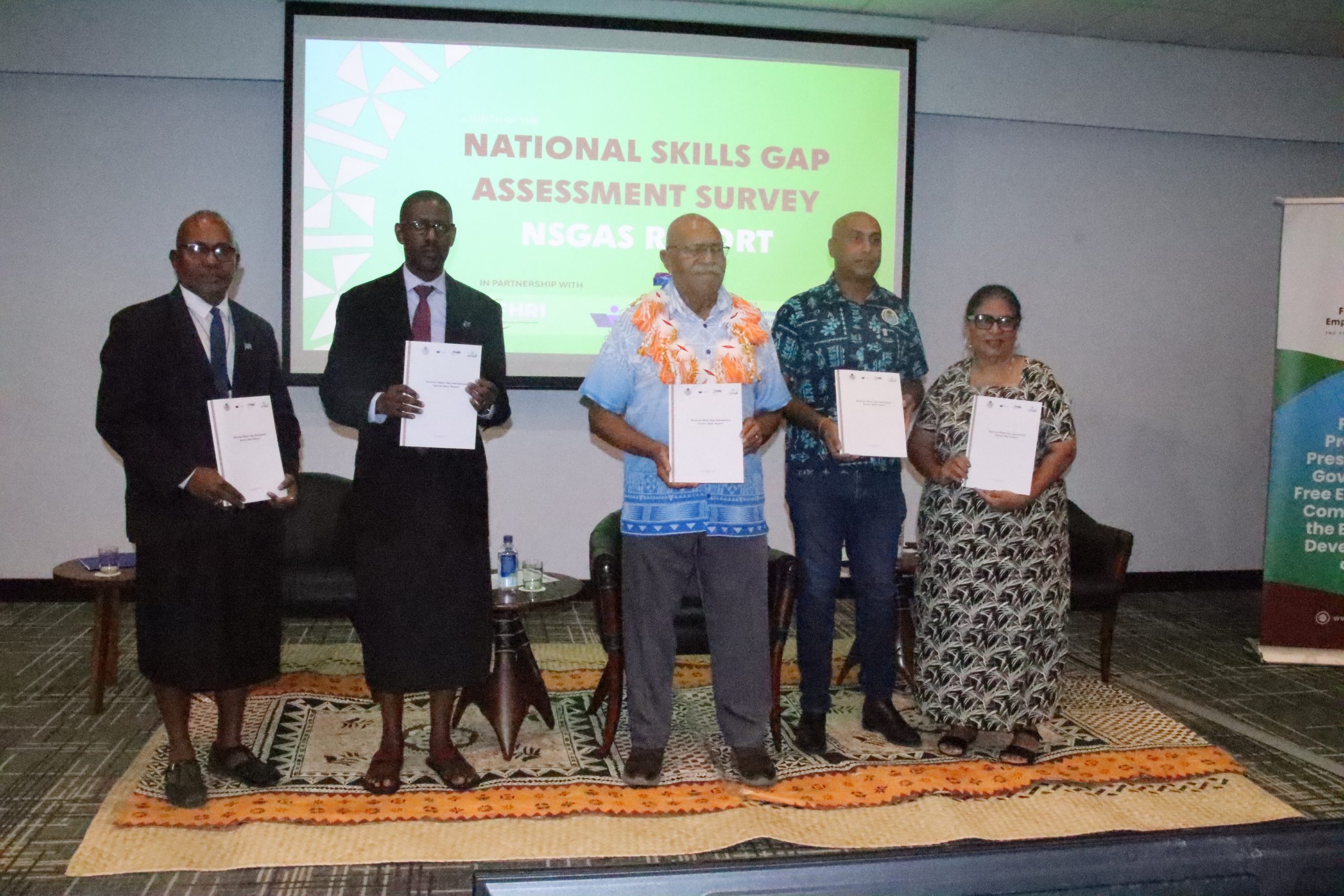
On Thursday the 7th of May, Fiji Commerce & Employers Federation (FCEF) in partnership with Fiji Human Resources Institute, Higher Education Commission Fiji, and the Fiji Government through the Fiji Bureau of Statistics launched the first of it’s kind National Skills Gap Assessment Survey (2025) – NSGAS.
The survey reports a telling story of Fiji’s skills & labour crisis – uncovering the reality, through data – of the scale and scope of this crisis.
The paradox between labour shortage and unemployment raises the question – what are we missing?
The Fiji Commerce & Employers Federation have summerised the key areas that needs to be addressed with urgency:
- 1. Supply Challenges
- Address supply side challenges with effective labour market policies or programmes urgently needed.
- The skills gaps are across all educational levels (high school, TVET, Academia) and industries.
- While there has been a 11% growth in Fiji’s labour force, the proportion of foreign workers grew by 79%.
- Widening gender gap of 16% + Youth not in employment or education NEET 26.6% (EUS, 2025)
- Majority of the skills losses are through overseas migration, including seasonal work programme.
- Need to prioritise local labour market first, then overseas.
- 2. 1% FNU Levy
- Employers need to access 100% of their 1% FNU levy ($25m) to attract and retain local workers
- Employers are investing in and prioritising local workers – recruiting foreign workers is their 4th choice.
- Employers currently can only access 10% of the 1% FNU Levy = $7.00 per worker
- 3. Foreign Workers
- Efficient and Safe Recruitment of foreign workers – continue to see upward trend – need to sustain business operations
- Form Bilateral agreements with Bangladesh, India, Solomon Islands, PNG and Tonga
- Improve efficiency of work permit processing
- Allow spouses of expatriate staff to work
- Allow regional students certain hours to work
As a nation if we are to achieve 5% GDP growth and move to a higher middle-income country, then it is imperative that local industries are prioritised, particularly in the supply of workers with the right qualifications, skills and behaviors demanded by the employers.
Thank you also to our technical working group
- International Labour Organization (ILO)
- International Organization for Migration (IOM)
- World Bank
- Pacific-Australia Skills
- Fiji Hotel & Tourism Association (FHTA)
FCEF highlight the importance of such public-private partnership, supported by our development partners. This survey is a testimony that we can work together to develop the evidence and address key challenges faced by both the private sector and Government.
Such models are proven to be effective and sustainable, and FCEF stands ready to work with Government and other partners on similar initiatives.
MEDIA UPDATES
SOCIAL MEDIA UPDATES
LAUNCH SLIDE DECK