
Fiji Times – 11 February 2026
The Employment Relations (Amendment) Bill 2025 proposes new and additional leave that includes women, but one that is very specific to women – menstrual leave. This could inadvertently discourage businesses from hiring women, despite the Government’s push for gender equality and women’s economic empowerment.
Clause 97 amends section 68 of the Principal Act by providing that where a worker has completed more than three months continuous service with the same employer may use three of her ten days paid sick leave during each year of service if she has severe or debilitating menstruation.
The new amendment states that, “(1A) A woman may use three of her 10 days of paid sick leave if at any time she experiences severe or debilitating menstruation.”
“Menstrual leave, though well-intentioned —is not supported by Fiji’s economic realities and may inadvertently influence some employers to favour male candidates over female applicants’, said Mr Edward Bernard, the CEO of the Fiji Commerce & Employers Federation (FCEF).
Additional leave proposed in the Bill that also includes women are three days family leave and two days annual leave.
Female participation in today’s labour market
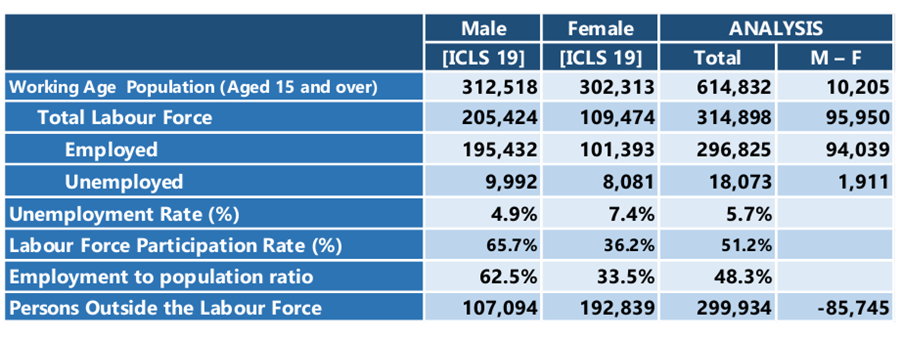
Women are disproportionately represented in our current labour market. Female participation is only 36.2% in labour, 21% in Board rooms, and 19% in business ownership.
The national unemployment rate for women in Fiji is 7.4%, compared to 4.9% for men. Female unemployment rate is 1.7% higher than the national unemployment rate of 5.7%. Furthermore, women represent the majority in youth unemployment (18%) and youth not in employment, education, or training (NEET) (26.6%).
Female participation in today’s labour market
Women are disproportionately represented in our current labour market. Female participation is only 36.2% in labour, 21% in Board rooms, and 19% in business ownership.
The national unemployment rate for women in Fiji is 7.4%, compared to 4.9% for men. Female unemployment rate is 1.7% higher than the national unemployment rate of 5.7%. Furthermore, women represent the majority in youth unemployment (18%) and youth not in employment, education, or training (NEET) (26.6%).
Fiji’s economic and business challenges
Fiji’s National Development Plan aims to increase female participation to 60% by 2030. The proposed increases in leave and new provision for menstrual leave could affect productivity and adding to the challenge of achieving this target.
In order to be competitive and be classified as a higher income country by 2050, Fiji’s GDP needs to grow at 5% per annum. However, Fiji’s economy grew at 3% last year and is forecasted to grow at 3% in 2026. The latest RBF economic review highlights as headwinds – higher imported inflation, weak tourism demand and lower remittance in-flows.
High cost of doing business, the skills and labour crisis and low productivity are major barriers to business growth and sustainability in Fiji.
In the last three years minimum wage and corporate tax have increased by 92% in total. Employers are investing more in attracting and retaining workers, including bearing the high cost of recruiting foreign workers so that their machines are operational and factories open. Our trend productivity rate is 1.2%, which is nowhere close to the 3.2% that our National Productivity Master Plan dictates.
There are about 50,000 registered MSMEs in Fiji, representing 82% of all formal businesses. These MSMEs are also required to comply with laws that enforce additional leave and higher costs. While MSMEs employ 60% of Fiji’s labour force, only 22,800 MSMEs are tax compliant. This is an indication that the majority of the MSMEs do not have the capacity to absorb additional and higher costs.
In the short to medium term, Global trade tensions, climatic events, potential increase in electricity tariffs, wait and see approach by investors in the lead up to national elections and the signing of the PACER Plus trade agreement would also add to the cost and sustainability of doing business in Fiji.
Countries that provide menstrual leave and their economic status
Japan – A pioneer in giving menstrual leave to women. Introduced in 1947 offering one day leave during their menstruation. Japan is the 5th largest economy in the world, and in 2025 was valued at U$4.28 trillion.
Indonesia – Indonesia has had a menstrual leave policy since 1948 and was renewed in 2003. Women have the right to take two days off every month. The country’s GDP growth in 2025 was 5.11%.
South Korea – The menstrual leave law in South Korea was introduced in 2001 one day leave. If this leave is not taken, then the company must pay a two-day salary. In 2025, South Korea’s GDP was valued at U$1.86 trillion.
Spain – Spain was the first country in Europe to provide menstrual leave in 2023. The law states that women will be given three days’ leave during their menstruation which can be extended to 5 days if required. In addition, the Spanish government has approved a decrease in the taxes applied to menstrual products (from 10% to 4%). A doctor’s letter is required and the public social security system covers the cost.
Taiwan – In 2002, the Gender Equality in Employment Law of Taiwan adopted three days’ leave for women with a half-salary. If it exceeds three days then it will be considered sick leave. In 2025, Taiwan’s GDP growth was 8.63%.
Zambia – The policy enacted in 2015 provides female employees one day off from work without medical certification, every month, during their menstruation. In Zambia, the policy is applicable for women who do not have children. In 2025, Zambia’s GDP growth was 5.8%.
Kanataka (India) – In November 2025, the Indian state of Kanataka passed a law allowing women aged 18 to 52 to take one day of menstrual leave every month, without medical certificate. The policy covers 350,000 to 400,000 women in the formal sector, although it excludes a much larger cohort – estimated to be six million – who are engaged as domestic workers, daily-wage labourers, and gig workers in the unorganised sector. Karnataka registered a Gross State Domestic Product (GSDP) growth rate of 10.2% in the 2023-24, higher than the national GDP growth rate of 8.2%.
Unintended implications
There is a valid concern that employers might become hesitant to hire women to avoid the “cost” of extra paid leave – including menstrual leave. Leading to an increase in the gender gap.
In many traditional or male-dominated workspaces, women may feel uncomfortable declaring “menstrual leave” to a male supervisor. Possibly fearing gossip or being labelled “unreliable.”
While including menstrual leave in a legislation is meant to provide legal grounding, Government’s capacity to ensure compliance is uncertain. This also includes rural and maritime MSMEs.
Opportunities to increase women’s economic participation.
About 192,839 women are currently outside the labour force and in the next few years will be transitioning into the labour market. We must ensure that there are effective pro gender policies in place to support the transition from school or training, into jobs.
At the same time, 109,473 women are already in the labour force. It is imperative that their employers are provided with fair and robust business environment that can sustain employment and economic growth.
As responsible Employers we understand and agree that we must fulfill our obligations to ensure that we comply and align with International Conventions that Fiji has ratified.
These international standards provide minimum labour standards. We must ensure that we are not over reaching in fulfilling our obligations by adopting maximum standards in this Bill that will adversely impact employment opportunities, business sustainability and economic growth.
■ FIJI COMMERCE & EMPLOYERS FEDERATION