
VOICE OF THE PRIVATE SECTOR – PACER Plus: What it means for Fiji
Voice of the Private Sector
The Fiji Times – 6th May 2026
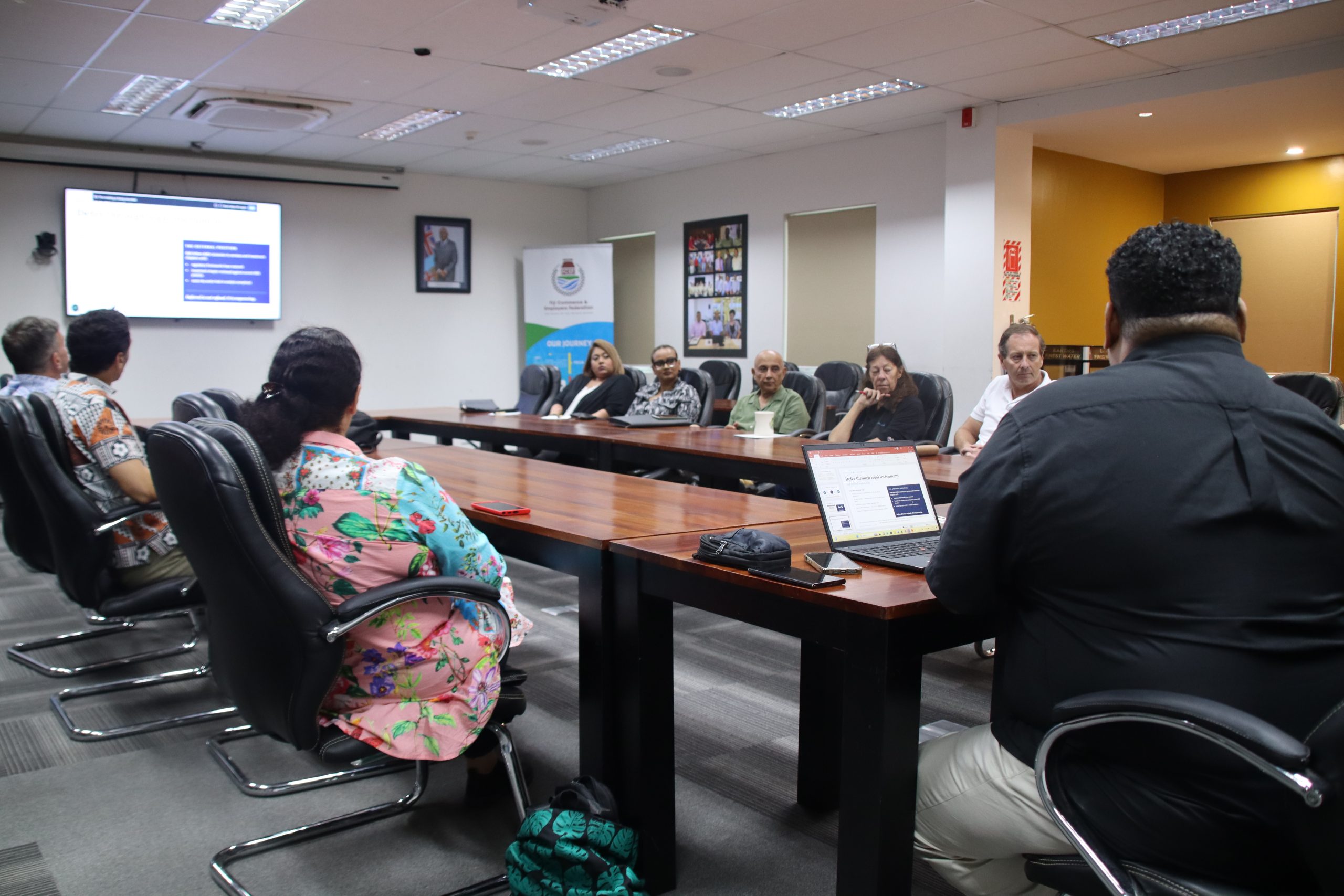
The Fiji Commerce and Employers Federation (FCEF), convened some of its members yesterday afternoon for an Expert Corner session on the Pacific Agreement on Closer Economic Relations Plus (PACER Plus) and its implications for Fiji’s economy. Led by Mr Shaheen Ali, trade expert and former Permanent Secretary for the Ministry of Trade, Co-operatives, MSMEs and Communications the session covered Fiji’s current trade landscape, the structure and design of the agreement, its potential implications for key sectors of the Fijian economy, and the considerations that should inform Fiji’s approach to engagement.
“PACER Plus is a significant agreement and Fiji’s engagement with it will shape our economic environment for decades. As the voice of the private sector, FCEF has a responsibility to ensure that members understand what is on the table, what the implications are for their industries, and how the private sector can contribute meaningfully to the national conversation. We are grateful to Mr Ali for sharing his expertise so generously, and we look forward to building on this conversation in the weeks and months ahead”, said Mr Eldon Eastgate – FCEF President
About PACER Plus
PACER Plus is a regional free trade agreement covering goods, services, and investment, supported by development assistance and labour mobility arrangements. On paper, it promises integration. In practice, however, the question Fiji must answer is far more specific: does this agreement deliver real economic transformation, or does it simply formalise what already exists?
Fiji and Papua New Guinea remain the only two Pacific Island countries yet to sign the PACER Plus agreement in its current form. From a private sector perspective, this position warrants careful examination — not because signature is the wrong outcome, but because the terms on which Fiji engages will shape its economic structure for decades.
Fiji already enjoys largely duty-free and quota-free access into key markets such as Australia and New Zealand through existing arrangements like the South Pacific Regional Trade and Economic Co-operation Agreement (SPARTECA) and other preference schemes. PACER Plus does not expand this access. Instead, it introduces a set of reciprocal obligations, particularly around tariffs, rules, and future policy space, that must be carefully weighed against the benefits.
“Fiji has a real opportunity here. The agreement raises legitimate questions that need to be worked through carefully — questions about design, sequencing, and the support arrangements that would accompany engagement. These are not reasons to step back. They are reasons to engage with greater clarity and stronger coordination. Fiji’s private sector has an essential role to play in shaping how this conversation moves forward.”
“What gives me confidence is that the relationships are already there. Through the Vuvale Partnership with Australia and the Duavata Partnership with New Zealand, Fiji is already engaged in deep cooperation that is delivering real outcomes for our people. The task now is to build on that foundation — to ensure that whatever framework Fiji eventually engages with reflects who we are, what we can offer, and what we need to grow.”
“This is a whole-of-country effort. Government, the private sector, workers, and our regional partners all have a part to play. When we move together, the outcomes are better — for Fiji, and for the Pacific”, said Mr Ali.
Fiji’s trade landscape
To understand why this matters, we must start with Fiji’s trade position. In 2025, Fiji recorded exports of approximately $2.53 billion against imports of $7.38 billion, resulting in a persistent trade deficit of $4.85 billion. This isn’t a one-off problem or a bad year, it’s been happening consistently over time, it is structural. Even more telling is the bilateral picture: deficits with Australia and New Zealand alone exceed $1.7 billion.
In this context, simply improving “market access” does not resolve the underlying issue. Fiji’s export base remains narrow and vulnerable, concentrated in a handful of products such as mineral water, fish, gold, garments, and sugar. The real constraint is not access to markets—it is the capacity to compete within them.
This is where several provisions of PACER Plus raise legitimate concerns.
First, “Most Favoured Nation” (MFN) clause means that if Fiji negotiates better trade terms with another country, those benefits would automatically extend to Australia and New Zealand. In effect, Fiji does the negotiating, while others benefit.
Second, safeguard provisions—these provisions have been designed to protect Pacific industries from import injury. But the conditions are so demanding that it has not been used. Similarly, industry development – provisions designed to support industry development carry restrictive conditions and a high burden of proof that limit their usefulness.
Third, tariff binding commitments could reduce Fiji’s fiscal flexibility. Tariff reductions on imports from Australia and New Zealand carry meaningful revenue implications for the national budget — implications that are significant for an economy of Fiji’s size and require careful assessment before any binding commitment is made. Binding tariffs at currently applied rates further constrains fiscal space, limiting the ability to adjust tariffs upward in response to future economic or trade shocks.
Beyond goods, the services and investment chapters carry long-term implications. Commitments in these areas can “lock in” policy settings for decades, limiting the Government’s ability to respond to future economic shifts. For a developing economy still building its regulatory and institutional capacity, this requires careful sequencing—not outright rejection, but not immediate commitment either.
So what should Fiji be negotiating?
Engagement is already happening through existing partnerships such as the Vuvale arrangement with Australia and Duavata with New Zealand, which are delivering tangible outcomes in labour mobility, education, and trade cooperation.
For PACER Plus to be meaningful, it must be accompanied by a targeted support package. This includes investment in trade-enabling infrastructure such as ports, biosecurity systems, and logistics; improved business mobility through streamlined visa access; expanded education and skills pathways; and sector-specific support for industries exposed to increased competition. Energy security and supply chain resilience must also form part of this conversation.
Fiji should secure bilateral arrangements with Australia and New Zealand that recognise its specific economic circumstances and address the structural concerns identified above. This is standard practice in modern trade agreements and ensures that Fiji’s specific circumstances are recognised.
The strongest economic outcomes for Fiji and the region will come from sustained dialogue, mutual recognition of each country’s specific circumstances, and a shared belief that the Pacific grows strongest when it grows together.
Next steps for FCEF
First, FCEF, working with the Fiji-Australia Business Council and the Fiji-New Zealand Business Council, will organise a follow-up session at which the Australian and New Zealand High Commissions will brief Fiji’s private sector directly on the agreement. This session will provide an opportunity for two-way engagement and ensure that members can raise questions and seek clarification from those closest to the agreement’s design and implementation.
Second, FCEF will convene a bilateral meeting with the Papua New Guinea Chamber of Commerce and Industry to explore a joint private-sector position. As the two largest economies in the Pacific Islands Forum, and as the two countries that have yet to sign in the agreement’s current form, Fiji and PNG share many of the same economic considerations. A coordinated private-sector voice from the two countries will strengthen the contribution that the private sector can make to regional and national deliberations.
“Our members came to yesterday’s session with serious questions and a clear appetite for engagement. That is exactly the kind of energy this conversation needs. The two next steps we have committed to — engagement with the High Commissions, and bilateral consultation with the PNG Chamber of Commerce and Industry — reflect FCEF’s commitment to constructive, well-informed advocacy on behalf of our members. We will continue to work closely with our partners across government, the regional business community, and our friends in Australia, New Zealand, and across the Pacific to ensure that Fiji’s private sector voice is heard, considered, and respected”, said Mr Edward Bernard, FCEF CEO.
FCEF reaffirms its commitment to working in the spirit of Vuvale and Duavata — partnerships that have shown what is possible when Pacific neighbours move together with trust, respect, and a shared commitment to one another’s success. The Federation notes that the strongest economic outcomes for Fiji and the region will come from sustained dialogue, mutual recognition of each country’s specific circumstances, and a shared belief that the Pacific grows strongest when it grows together.
■ FIJI COMMERCE & EMPLOYERS FEDERATION